


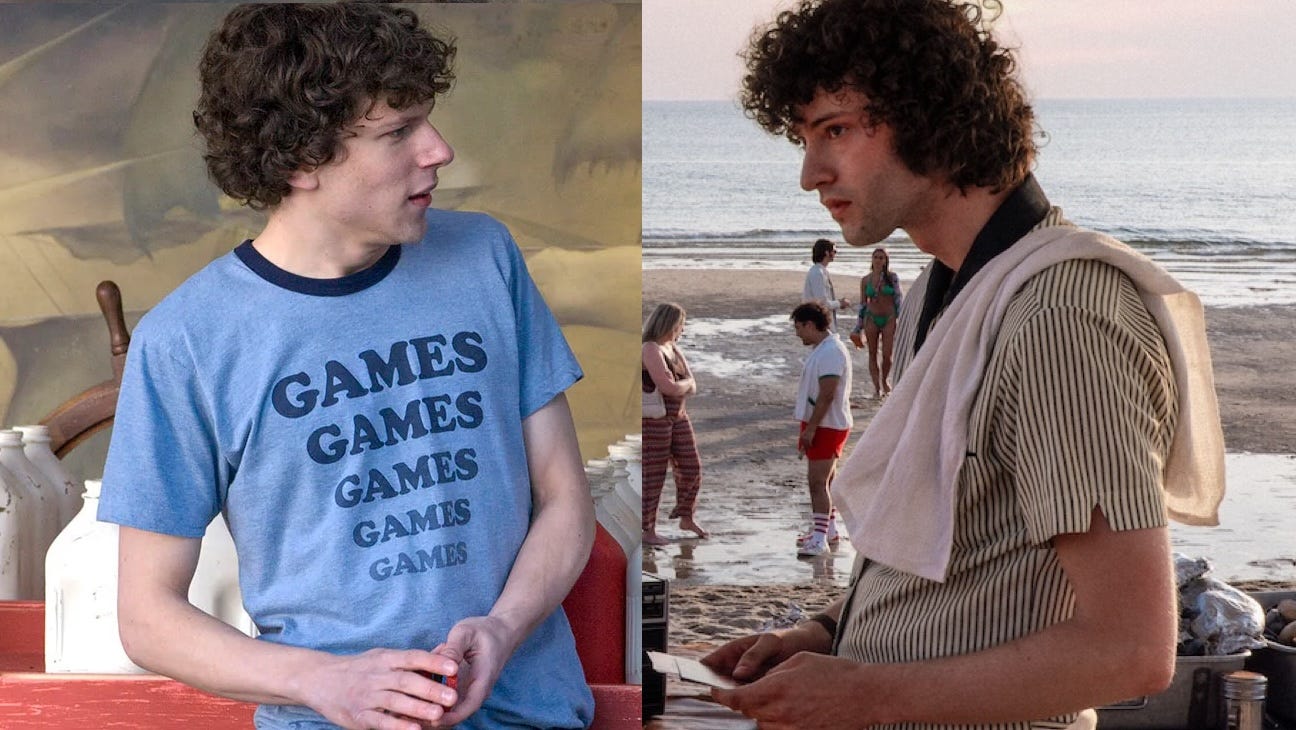
Coming off the one-two punch of 2023’s BlackBerry and this year’s Nirvanna the Band the Show the Movie, I had high hopes for Tony, the latest from filmmaker Matt Johnson. And I’m glad to report that, for at least 75% of its runtime, this biopic, about a particularly eventful summer in the life of a young Anthony Bourdain, is pretty good.
But it’s not great.
To better understand Tony’s shortcomings, I suggest we look at another movie, which tells a very similar story but is a considerably stronger film: Greg Mottola’s semi-autobiographical 2009 film, Adventureland.
That might seem, on the surface, like an odd point of comparison…
…but the overlap between the two movies is considerable.
Tony, set in Cape Cod in the summer of 1975, is about a college-aged aspiring writer from a dysfunctional family who, after failing to land a fellowship for which he thought he was a shoo-in, is forced to take a menial job in which he has no real interest - specifically, working in the kitchen of a local dive. Needless to say, he makes new friends, falls in love, and has experiences, both positive and negative, that will shape the rest of his life. The movie ends with him moving to New York to attend the prestigious Culinary Institute of America.
Adventureland, set in Long Island in the summer of 1987, is about a college-aged aspiring writer from a dysfunctional family who, after having to cancel a highly anticipated trip to Europe due to his father’s abrupt unemployment, is forced to take a menial job in which he has no real interest - specifically, working a game booth at an amusement park. Needless to say, he makes new friends, falls in love, and has experiences, both positive and negative, that will shape the rest of his life. The movie ends with him moving to New York to attend the prestigious Columbia School of Journalism.
Now, obviously, there are differences between the two pictures. For one thing, they have different tones (Tony is a drama with comedic elements, while Adventureland is a comedy with dramatic elements) and plots (which I’ll delve into momentarily). And Bourdain (played by Dominic Sessa from The Holdovers) is a much more morally flexible character than the protagonist of Adventureland, James (played by Jesse Eisenberg); one might, in fact, argue that Tony is ultimately a more complex protagonist than James.
But where Adventureland has Tony beat, hands down, no question, is the supporting characters.
Tony’s love interest is a classmate named Nancy (Emilia Jones), and she’s the whole reason Tony winds up in Cape Cod in the first place: after he finds out he didn’t get the fellowship, he more or less winds up stalking her.
Nancy’s defining characteristic is her attractiveness (one of Tony’s friends calls her “unapproachable”). If there’s any other reason for Tony to be so into her, that’s never made clear; I mean, she seems nice enough, but other than the fact that she likes photography, we don’t get any real sense of who she is as a person.
For that matter, I could not for the life of me tell you what Nancy sees in Tony. She seems kind of impressed by his bravado at first, I suppose? But that’s really about as far as it goes. They fall for each other via the kind of hand-wave montage that The Naked Gun should have killed nearly 40 years ago. But that doesn’t exactly sell the romance.
In other words: these characters have no real relationship.
This would be a narrative issue regardless, but it’s especially problematic for Tony because Bourdain spends most of the movie lying to Nancy, claiming he got the fellowship when he didn’t, asserting it’s merely a coincidence that he’s on Cape Cod at the same time she is, and pretending that the only reason he’s working in the kitchen of a not-especially-great restaurant is to do research for a novel he’s not even actually writing. When Nancy stands before him, naked, ready to hop into bed, he finally comes clean about all these deceptions even though it means blowing his chance to sleep with her, and that’s admirable enough… but she forgives him much too easily, and largely as the result of yet another mistruth (i.e., that a clam bake designed to make money for him is a charity event). And not only does she forgive him, but she’s disappointed when he doesn’t continue to pursue her after they make amends. In other words, the movie wants us to believe that she’s really into him, but it never does the work necessary to sell that idea.
Contrast this with the love story between James and his co-worker at the amusement park, Em (Kristen Stewart). It’s clear that James finds Em attractive from the moment they meet… but it’s also clear that’s not the only thing he likes about her. Mottola spends quite a bit of time with the two characters, letting us get to know Em almost as much as we know James, and very clearly dramatizing what brings them together - that each accepts the other’s authentic self.
Em’s family wants her to get over the death of her mother and behave and dress in a more “proper” manner; she’s having an affair with the park’s older, married maintenance worker, Mike (Ryan Reynolds), and it’s heavily implied that his interest in her is purely physical. But James doesn’t want Em to change - he likes her just the way she is.
Similarly, James has continuously struck out with girls who see him as needy and uncool; he’s embarrassed to tell Em he wants to be a travel writer, and earnestly surprised when she encourages his passion. James’ sincere interest in who Em is as a person engenders Em’s sincere interest in who James is as a person, and they begin to fall in love.
In fact, Adventureland goes out of its way to demonstrate that James and Em have a connection that’s much deeper than simple sexual desire. As James’ relationship with Em develops, he becomes more self-confident, which earns him the attention of the park’s resident babe-everyone-lusts-after, Lisa P. (Daredevil: Born Again’s Margarita Levieva). And when Em briefly rejects James, precisely because things between them are getting too real and she can’t handle that level of intimacy, James goes on a date with Lisa P. And while they briefly make out, it’s clear that they have no real connection - Lisa P., whose greatest desires in life are to tan by the pool and go clubbing, is much too artificial for James. The next day, James comes clean to Em about his date with Lisa P., and his honesty - in contrast with Mike’s deceitfulness - further endears him to her.
Put more simply: Mottola does an excellent job dramatizing why James and Em fall in love, while Johnson asks us to buy into the romance simply because, well, it’s there.
Em being such a better-developed character than Nancy alone would be enough to make Adventureland superior to Tony… but the thing is, nearly every supporting character in Adventureland is better developed than their counterparts in Tony.
In Tony, when Bourdain first begins to pursue Nancy, she’s already dating some other dude. I don’t think we ever learn this guy’s name; he has maybe one audible line of dialogue. One of Nancy’s friends does say he has “a big dick,” so that’s useful character information, I guess.
In Adventureland, James’ romantic rival is the aforementioned Mike. But James doesn’t even know about Mike and Em’s affair until very late in the story. In the meantime, he sees Mike as a kind of cool mentor/older brother - and initially, we see him that way, too.
Of course we judge Mike for being a married man in his 30s who is taking advantage of a college student, but we also come to see how deeply miserable and pathetic Mike is. He’s a failed musician; he tells everyone he’s moving to “the big city” to continue to pursue his dreams, but this is clearly bullshit. He also tells everyone he once jammed with Lou Reed… but James figures out that’s a lie, too, when Mike first doesn’t recognize one of Reed’s songs on the radio and then erroneously refers to “Satellite of Love” as “Shed a Light on Love.” In their last scene together, it becomes clear that James pities Mike. Making Mike this schmuck who has to lie to younger women to feel good about himself doesn’t make him sympathetic by any stretch of the imagination, but it does make him feel like a lived-in character with an existence outside of the frame.
And yes, James has co-workers who are basically one-dimensional stock characters, but he also has co-workers who are incredibly well-defined, whether we learn the details of their backstory or not. In addition to Em and Mike, for example, there’s Joel (Martin Starr), a kind of funhouse mirror version of James who is extremely intelligent and has a brilliant, dry sense of wit, but is largely lacking in self-confidence. He smokes a pipe - which even he admits is an “affectation” - and is rejected by a girl he likes because he’s Jewish. Joel is clearly envious of James’ relationship with Em, and angry with James for casually jeopardizing the emotional intimacy he himself cannot achieve. Joel, like Em and Mike and even Lisa P., feels like a real person.
In Tony, we barely get to know any of Bourdain’s co-workers in the kitchen, besides two warring mentors: Sal (Leo Woodall), a hedonistic, self-destructive sociopath, and Chef (Antonio Banderas), his devoutly Catholic, distinctly regret-filled boss. Neither has the contrasting qualities that give a character depth. Mike is cool and pathetic; Em is cynical and vulnerable. Sal is just a bad guy, while Chef is just a perfect angel. What demons haunt Sal, who freely abuses cocaine and, later, heroin? Does Chef have any flaws, outside of seeming to have given up on himself as a world-class cook? No idea.
That lack of contradiction makes Nancy, Chef, and Sal feel less like characters than plot devices.
That Tony is so entertaining despite these shortcomings is a testament to Johnson’s talents as a filmmaker and the cast’s gifts as performers. But the people surrounding Bourdain never quite feel like people in their own right. The supporting characters in Adventureland, on the other hand, seem to have lives that continue even when James isn’t around to see them. That difference may sound small, but it’s the difference between a world populated by archetypal placeholders and one populated by human beings — and it’s what leaves Tony merely one of the better movies of 2026, rather than one of the best.
what a delight to see this show up in my inbox. Welcome back~!!